


.svg)


The proprietary trading industry has exploded in popularity, offering retail traders access to six-figure capital for a small upfront fee. But this incredible opportunity often leads to a logical question: If a firm is giving me $100,000 to trade and letting me keep 80% of the profits, how are they actually making any money?
Understanding the business model behind prop firms is the key to distinguishing a legitimate firm from a scam.
In this guide, we will pull back the curtain on the prop firm industry, explain exactly how the revenue model works, and show you why partnering with a transparent firm is the most important decision you will make as a trader.
The Two Primary Revenue Streams
Modern prop firms rely on a combination of two revenue streams to remain profitable. How heavily a firm leans on one versus the other determines whether they are a legitimate partner or a predatory trap.
1. Evaluation (Challenge) Fees
When you sign up for a prop firm challenge, you pay an upfront fee (e.g., $500 for a $100k account). This fee serves three purposes:
- Filtering Gamblers: It ensures only serious traders apply. If the accounts were free, people would open thousands of them and gamble wildly.
- Covering Overhead: It pays for platform licensing (like MetaTrader 5 or Match-Trader), data feeds, customer support, and payment processing.
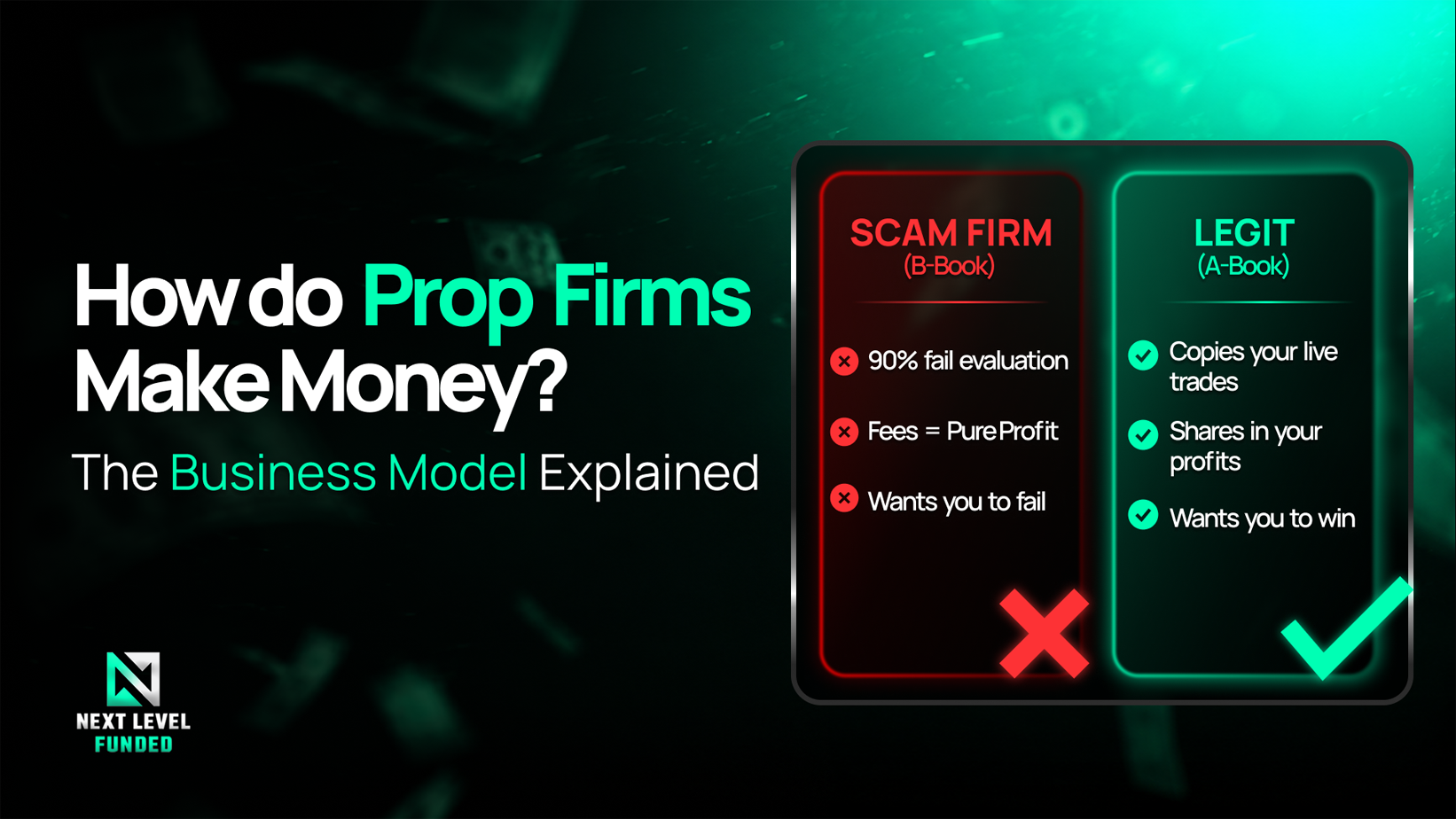
- Funding Payouts (The B-Book Model): In the prop firm industry, the harsh reality is that over 90% of traders fail their evaluations. Predatory firms (often called "B-Book" firms) keep these failed fees as pure profit and use them to pay the tiny percentage of traders who actually pass.
2. Profit Splits from Funded Traders (The A-Book Model)
This is how legitimate prop firms want to make their money.
When a trader proves they are consistently profitable by passing an evaluation, a legitimate firm will copy that trader's live trades into a master corporate account with real capital (known as "A-Booking").
If the trader makes $10,000 in profit, the trader keeps $8,000 (an 80% split), and the firm keeps $2,000. By aggregating the trades of hundreds of successful funded traders, the firm generates massive, sustainable revenue from the live markets.
The Difference Between Legit Firms and Scams
The business model a firm chooses dictates how they treat their traders.
A firm that relies entirely on failed evaluation fees is mathematically incentivized to make you fail.
The Next Level Funded Business Model
At Next Level Funded (NLF), our business model is built entirely around trader success. We do not want your evaluation fee; we want your profitable trades.
This is why we are one of the only firms to offer 100% Refundable Challenge Fees. When you pass an NLF evaluation and receive your first payout, we refund your initial challenge fee in full.
We make our money by partnering with the best traders in the world and sharing in their success.
- No Hidden Rules
- Up to 100% Profit Splits
- On-Demand Payouts
- Instant Funding Options Available
Stop trading with firms that are betting against you. Partner with a firm that only wins when you win.
More Blogs


September 12, 2026
Can You Have Multiple NLF Instant Flex Accounts? $10K Limits, Larger Account Options & $500K Cap Explained
Read Story
September 8, 2026
Best $10K Instant Funded Account for Beginners? NLF Instant Flex Rules, Price and Payout Limit
Read Story© Next Level Funded 2026 | All Rights Reserved


