


.svg)


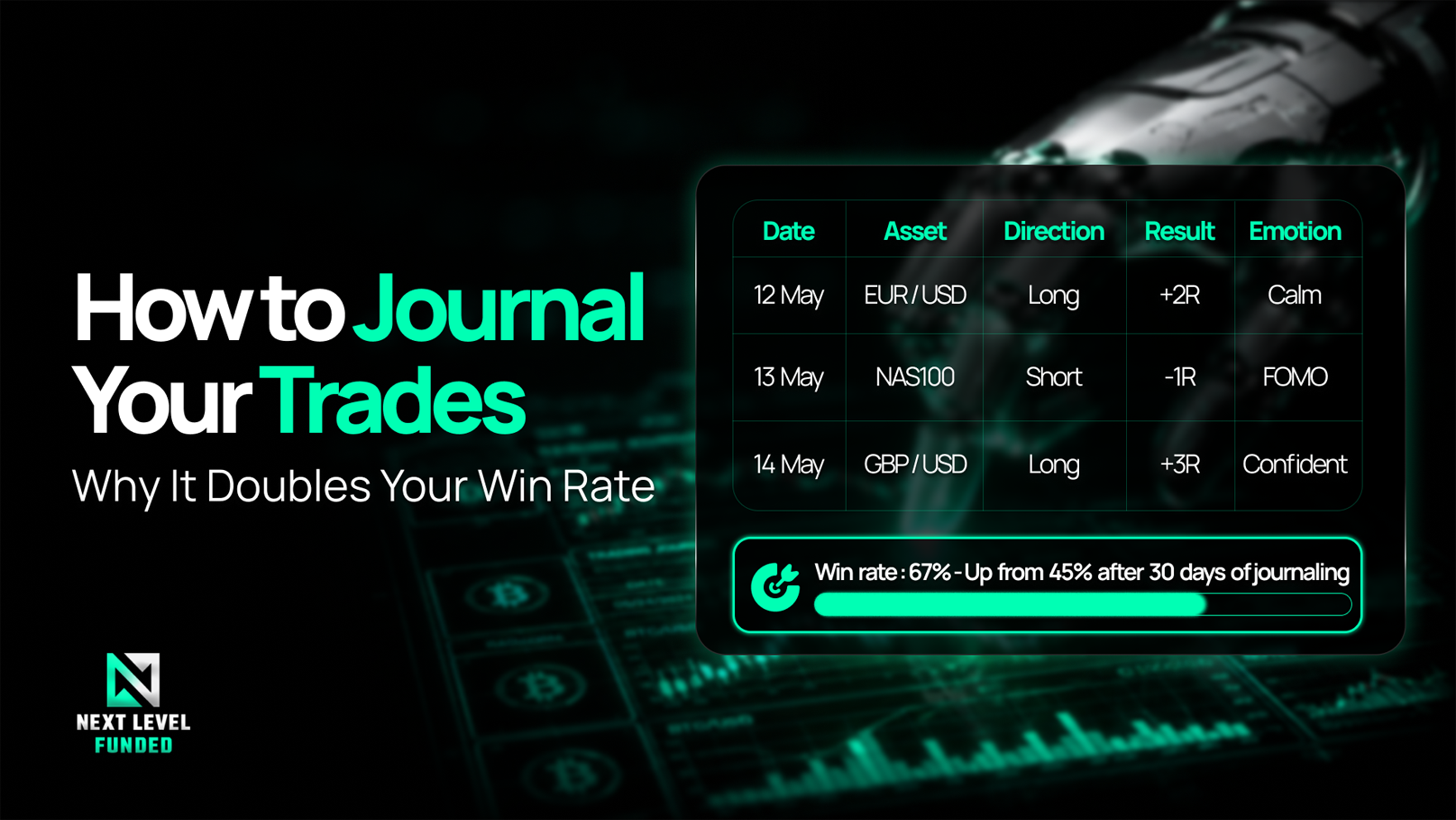
Trading without a journal is like running a business without accounting software. You might feel like you are working hard, but you have no idea where the money is actually going.
Most amateur traders finish their trading session, close their laptop, and walk away. Professional traders finish their session and immediately open their trading journal.
A trading journal is not just a diary; it is a diagnostic tool. It reveals exactly which setups are making you money and which habits are destroying your account. In this guide, we will show you exactly how to journal your trades, what data points to track, and how to use that data to pass your Next Level Funded evaluation.
Why Journaling Improves Your Win Rate
The math behind journaling is undeniable. According to trade journal software analytics, traders who consistently log and review their trades see a measurable improvement in their win rate.
Why? Journaling removes emotion and replaces it with data.
If you feel like "trading on Fridays is always bad," a journal will prove whether that is true. You might discover that your win rate on Tuesdays is 65%, but your win rate on Fridays is 30%. Armed with that data, you simply stop trading on Fridays, instantly improving your overall profitability.
What Data Should You Track?
A professional trading journal tracks two types of data: Quantitative (the hard numbers) and Qualitative (the context and psychology).
1. Quantitative Data (The Numbers)
Every trade entry in your journal must include:
- Date and Time: When did you enter and exit?
- Asset: What pair or index did you trade (e.g., EUR/USD, NAS100)?
- Direction: Long or Short?
- Entry Price: The exact price your order was filled.
- Stop Loss & Take Profit: Your planned risk parameters.
- Position Size: The lot size used.
- Result (R-Multiple): Did you make 2R (twice your risk) or lose 1R?
2. Qualitative Data (The Context)
This is where the real breakthroughs happen. You must record:
- The Setup: Why did you take the trade? (e.g., "15m Order Block with 5m CHoCH").
- Emotional State: How did you feel before entering? (e.g., "Felt rushed, FOMO").
- Trade Management: Did you move your stop loss prematurely? Did you take partial profits?
- Screenshots: Always include a screenshot of the chart at the moment of entry, and a screenshot of the chart after the trade played out.
How to Review Your Journal
Recording the data is only half the job. You must actually review it to find your edge.
At the end of every week, spend one hour reviewing your journal. Look for patterns:
- Are 80% of my losses coming from revenge trading after 10 AM?
- Is my "Breakout" strategy losing money, while my "Pullback" strategy is highly profitable?
- Am I consistently moving my stop loss to breakeven too early and getting stopped out before the trade runs?
Once you identify the pattern, create a new rule for the upcoming week to eliminate the leak.
Journal Your Way to a Funded Account
The discipline required to maintain a trading journal is the exact same discipline required to pass a prop firm evaluation.
At Next Level Funded (NLF), we provide the capital to traders who have proven they can manage risk and execute their edge flawlessly.
- Up to 100% Profit Splits
- No Hidden Rules
- On-Demand Payouts
- Instant Funding Options Available
Start journaling your trades today. Find your edge, eliminate your mistakes, and then bring that edge to NLF to scale your income.
More Blogs


September 23, 2026
This Is the Cheapest Instant Funding Account Ever Created in the Prop Firm Industry? NLF $10K Instant Flex
Read Story
September 21, 2026
The $9.90 For $10K Instant Funded Account: NextLevelFunded Launched Cheapest Instant Funding Account Ever
Read Story© Next Level Funded 2026 | All Rights Reserved


