


.svg)


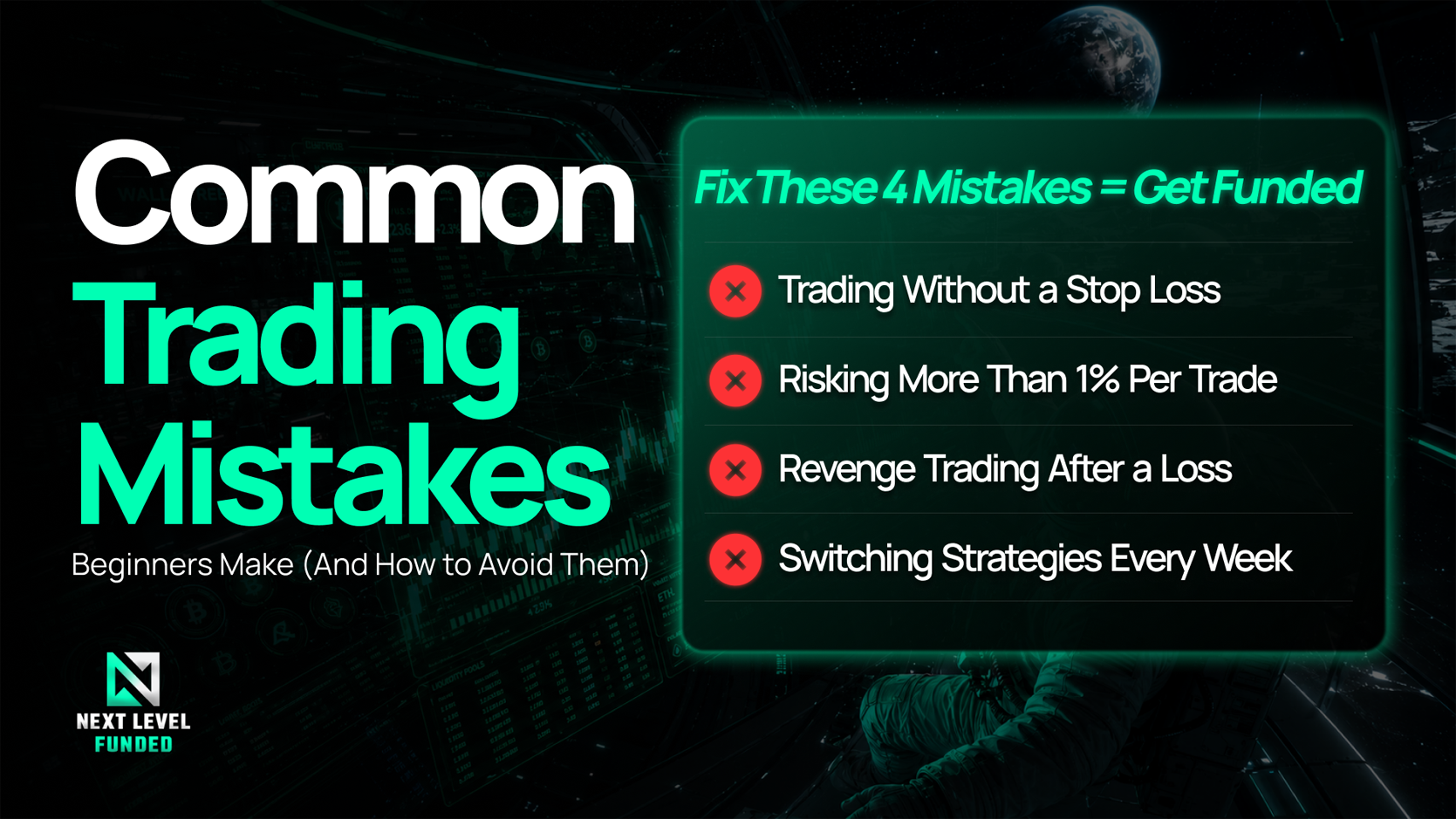
Trading the financial markets is one of the most difficult skills to master. It requires a combination of statistical probability, flawless execution, and unbreakable emotional control.
Unfortunately, human psychology is hardwired to do exactly the opposite of what successful trading requires. When beginners enter the market, they almost always fall into the same predictable psychological traps.
If you are currently failing prop firm challenges or blowing personal accounts, you are likely making one of these four common trading mistakes. Here is how to identify them and, more importantly, how to fix them.
Mistake 1: Trading Without a Stop Loss
This is the cardinal sin of trading. Beginners often enter a trade without a stop loss, convincing themselves they will "close it manually if it goes too far against me."
When the trade inevitably goes against them, hope takes over. They hold onto the losing position, hoping it will reverse, until a small manageable loss turns into a blown account.
How to Avoid It: Never enter a trade without a hard stop loss placed in your broker platform. Your stop loss should be placed at the exact structural level where your trade idea is invalidated. Accept that taking small losses is the cost of doing business in trading.
Mistake 2: Poor Position Sizing (Risking Too Much)
Many beginners treat trading like a lottery ticket. They fund an account with $500 and risk $100 on a single trade, hoping to double their money overnight. Risking 20% of your account on one trade guarantees that a normal losing streak will wipe you out completely.
How to Avoid It: Adopt the 1% Risk Rule. Never risk more than 1% of your total account capital on any single trade. Use a position sizing calculator to determine exactly how many lots you should trade based on the distance to your stop loss. If you want to make larger dollar amounts per trade, you need a larger account—not larger risk.
Mistake 3: Revenge Trading
You take a perfectly valid setup, but the market sweeps your stop loss and then immediately runs to your target. Frustrated and angry, you immediately re-enter the market with double the lot size to "win back" the money you just lost. This is revenge trading, and it is the fastest way to hit a daily drawdown limit.
How to Avoid It: Implement a "walk away" rule. If you take two consecutive losses in a single session, close your charts and walk away from your computer for the day. The market will still be there tomorrow.
Mistake 4: Strategy Hopping
Beginners often blame their strategy when they lose money. They try the "RSI Strategy" for a week, take three losses, and immediately switch to "Smart Money Concepts." A week later, they switch to "Fibonacci Retracements." Because they never stick with one strategy long enough to understand its nuances, they never achieve consistency.
How to Avoid It: Understand that every strategy has losing streaks. Choose one strategy that makes sense to you, backtest it over 100 trades to prove its statistical edge, and then trade it flawlessly for at least three months before making any adjustments.
The Ultimate Fix: Trade with Next Level Funded
The fastest way to cure bad trading habits is to trade within a structured environment.
When you take a prop firm challenge with Next Level Funded (NLF), our strict risk management rules force you to become a disciplined trader.
- Our 5% Daily Drawdown limit prevents you from revenge trading.
- Our 10% Overall Drawdown limit forces you to use proper position sizing.
- Our Up to 100% Profit Splits mean you don't have to risk huge percentages to make serious money.
Stop making the same beginner mistakes. Adopt professional risk management, pass the evaluation, and get funded today.
More Blogs


September 12, 2026
Can You Have Multiple NLF Instant Flex Accounts? $10K Limits, Larger Account Options & $500K Cap Explained
Read Story
September 8, 2026
Best $10K Instant Funded Account for Beginners? NLF Instant Flex Rules, Price and Payout Limit
Read Story© Next Level Funded 2026 | All Rights Reserved


