


.svg)


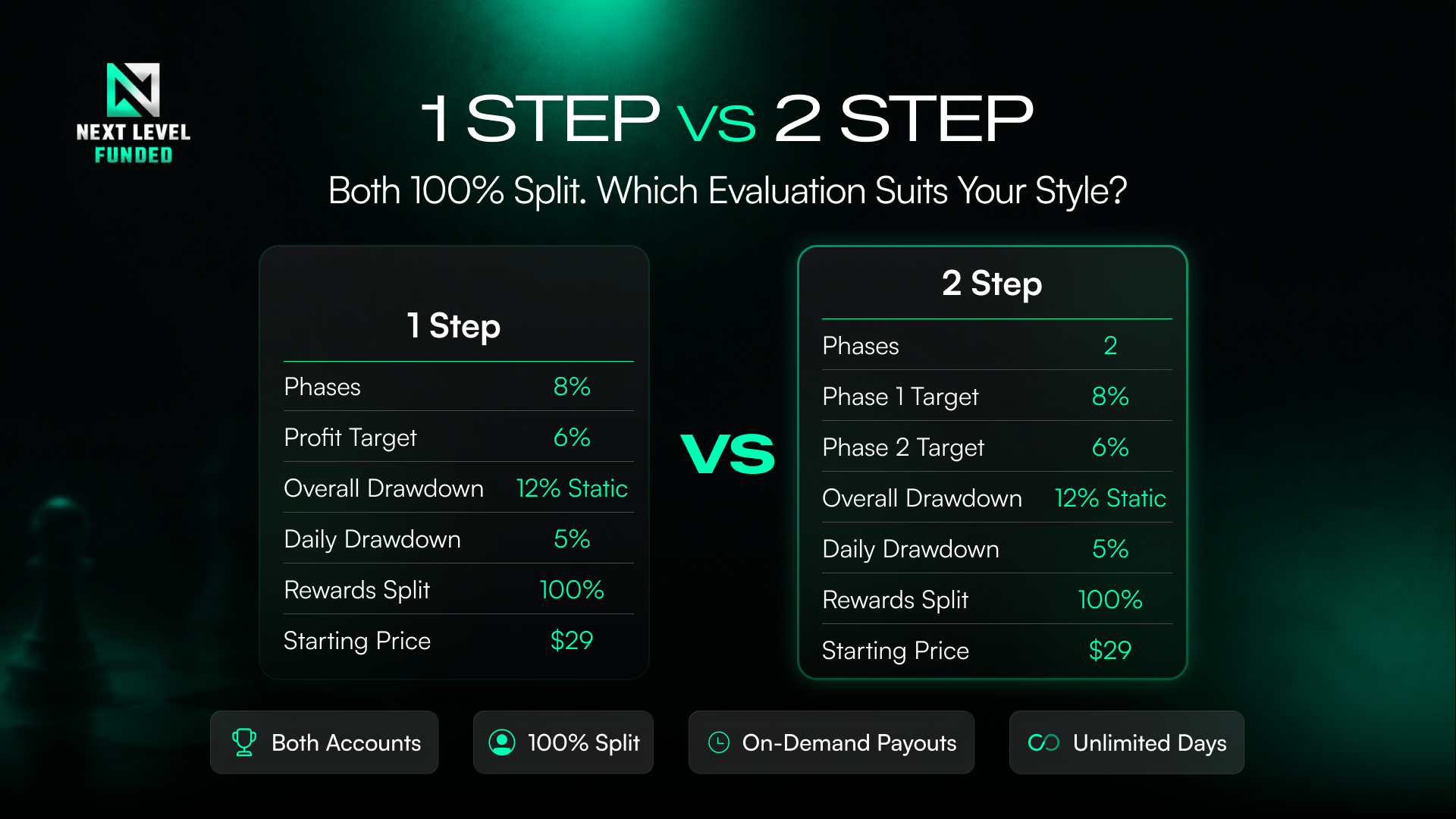
It is a great question, because both accounts share the same ultimate destination — a fully funded account with a 100% profit split and on-demand payouts — but they take meaningfully different routes to get there. The differences in structure, drawdown protection, and pricing make each account the clear winner for a specific type of trader.
In this guide, we break down the exact rules of the NLF 1-Step vs 2-Step, explain the key trade-offs, and give you a definitive recommendation based on your trading style.
Head-to-Head Comparison Table
Here is the complete side-by-side breakdown of every key metric:
Deep Dive: The 1-Step Account
The 1-Step evaluation is the most direct route to a funded account at NLF. Pass a single phase, hit one profit target, and you are funded. No second phase. No additional hurdles.
The Key Advantage: Speed and Simplicity
With only one phase to pass, the 1-Step is the fastest path to a funded account in the NLF evaluation lineup. If your strategy consistently generates 2–3% per week, you can realistically pass the 8% target in three to four weeks and begin earning on a funded account immediately.
The simplicity of a single phase also removes the psychological complexity of transitioning between Phase 1 and Phase 2. You have one objective, one drawdown to manage, and one milestone to hit.
The Trade-Off: Tighter Drawdown
The 1-Step uses a 7% static overall drawdown and a 3% daily drawdown. On a $5,000 account, your maximum loss limit is $350 and your daily ceiling is $150. While these parameters are perfectly manageable for disciplined traders who use tight stop losses, they leave less room for error than the 2-Step account.
Best For: Scalpers, day traders, and high-frequency traders who use tight stop losses and want to get funded as quickly as possible with a single, clean phase.
Deep Dive: The 2-Step Account
The 2-Step evaluation is NLF's most popular funding path. It requires traders to prove consistency across two separate phases, but compensates them with the widest drawdown protection in the NLF evaluation lineup and the lowest entry price.
The Key Advantage: Maximum Drawdown Protection at the Lowest Price
The 2-Step account features a 12% static overall drawdown and a 5% daily drawdown — the most generous evaluation parameters at NLF. On a $5,000 account, your maximum loss limit is $600 and your daily ceiling is $250. This is 71% more total drawdown protection than the 1-Step account.
This extra room is transformative. Swing traders who hold positions for days, traders who use wider stop losses to avoid being stopped out on wicks, and traders who want to trade through high-volatility news events will find the 2-Step dramatically more comfortable to navigate.
Adding to this, the 2-Step starts at just $29 — $8 cheaper than the 1-Step. It is the most cost-effective evaluation in the NLF lineup.
The Trade-Off: Two Phases to Pass
The 2-Step requires you to pass two separate phases before being funded. Phase 1 requires an 8% profit target. Phase 2 requires a 6% profit target. While the targets themselves are very achievable, the two-phase structure does mean a longer overall timeline compared to the 1-Step.
However, it is worth noting that the Phase 2 target of 6% is lower than Phase 1, and the same generous 12% overall drawdown applies across both phases. Many traders find Phase 2 significantly easier than Phase 1 because the lower target creates less psychological pressure.
Best For: Swing traders, position traders, news traders, and anyone who values maximum drawdown protection. Also the best choice for traders who are newer to prop firm evaluations and want the widest safety net available at the lowest price.
The Critical Difference: Drawdown Philosophy
The single most important factor separating these two accounts is their drawdown philosophy, and it is worth examining in detail.
The 1-Step's 7% static drawdown means your maximum loss from your starting balance is 7%. On a $10,000 account, you can lose a maximum of $700 before the account is breached.
The 2-Step's 12% static drawdown means your maximum loss from your starting balance is 12%. On a $10,000 account, you can lose a maximum of $1,200 before the account is breached.
That is a $500 difference in loss tolerance on a $10,000 account — a significant buffer that can be the difference between surviving a difficult week and failing a challenge. For traders who have experienced the frustration of failing an evaluation on a single bad day, the 2-Step's wider drawdown is a compelling reason to choose it over the 1-Step.
Which Account Should You Choose?
Choose the 1-Step ($37) if:You are a fast, disciplined trader who uses tight stop losses and wants to get funded in the shortest possible time. You are confident in your ability to hit 8% without needing a large drawdown buffer, and you prefer the simplicity of a single-phase challenge.
Choose the 2-Step ($29) if:You are a swing trader, a news trader, or anyone who needs room to breathe. The 2-Step is $8 cheaper, offers 71% more drawdown protection, and is the most forgiving evaluation in the NLF lineup. If you have ever failed a challenge due to a single bad day, the 2-Step's 12% static drawdown and 5% daily limit will give you the buffer you need to trade without fear.
Both accounts deliver the exact same funded trader experience: a 100% profit split, on-demand payouts, and the NLF 12-Hour Payout Guarantee. The only question is which path gets you there most comfortably.
Start Your 1-Step or 2-Step Evaluation Today
Author: Spencer Todd, Founder of Next Level Funded
More Blogs


September 12, 2026
Can You Have Multiple NLF Instant Flex Accounts? $10K Limits, Larger Account Options & $500K Cap Explained
Read Story
September 8, 2026
Best $10K Instant Funded Account for Beginners? NLF Instant Flex Rules, Price and Payout Limit
Read Story© Next Level Funded 2026 | All Rights Reserved


