


.svg)


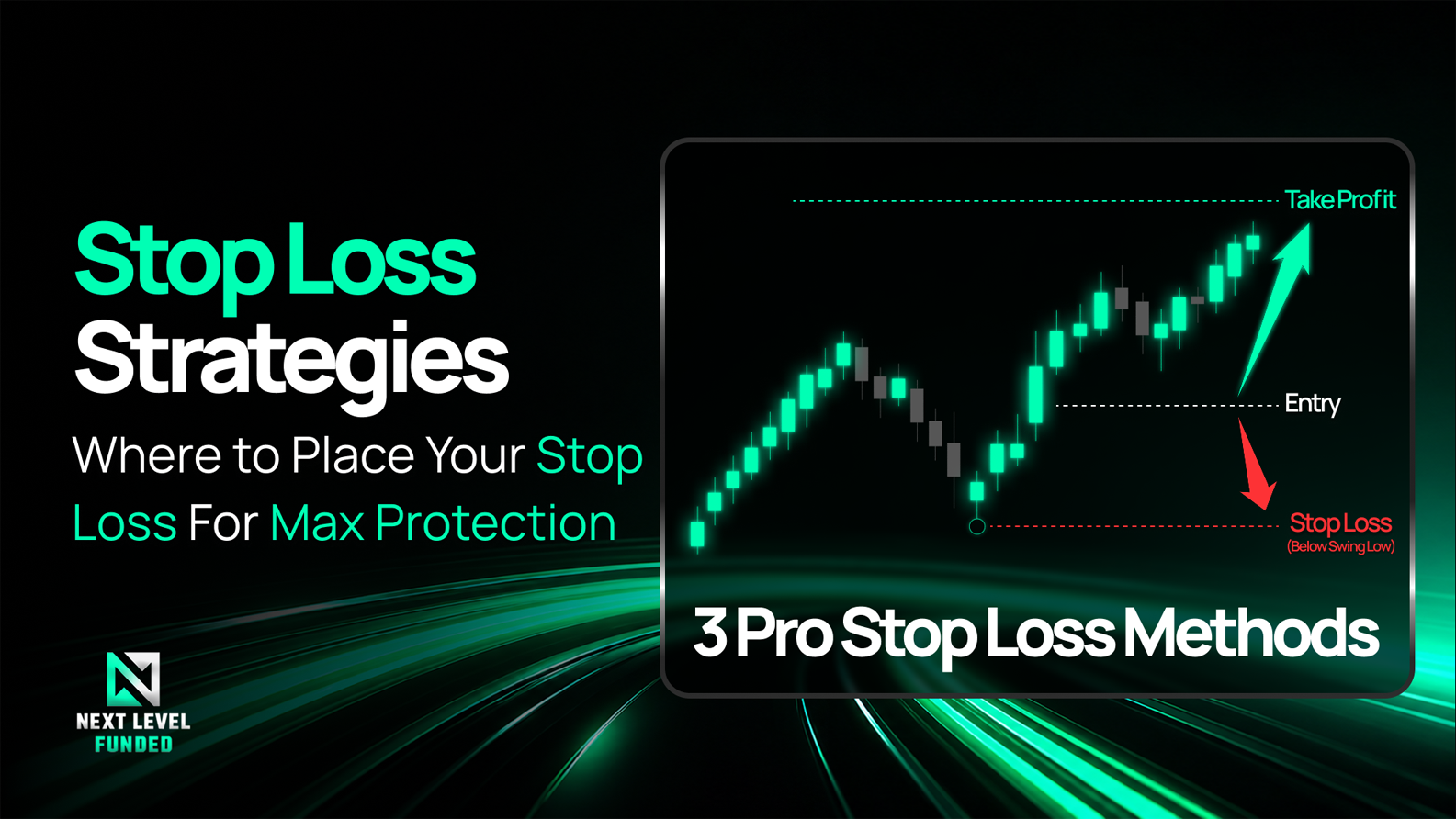
Every trader has experienced the ultimate frustration: You enter a trade, place your stop loss, and watch as the price spikes down, hits your stop loss to the exact pip, and then immediately reverses to hit your profit target.
You were right about the direction of the market, but you still lost money.
This happens because your stop loss placement was arbitrary. If you are placing your stop loss "20 pips away" just because 20 pips feels like a good number, you are trading based on hope, not market structure.
In this guide, we will break down the professional stop loss strategies used by funded traders to maximize protection, avoid liquidity sweeps, and keep their accounts safe from daily drawdown limits.
The Golden Rule of Stop Loss Placement
Before we look at specific strategies, you must understand the golden rule of stop loss placement:
Your stop loss must be placed at the exact price level where your trade thesis is proven wrong.
If you are buying because the market is in an uptrend, your stop loss should be placed below the level that would break the uptrend. Your stop loss should not be based on how much money you want to lose; your position size should be adjusted based on the distance to your logical stop loss.
3 Professional Stop Loss Strategies
1. Market Structure Placement (Swing Highs/Lows)
This is the most reliable and widely used stop loss strategy. It relies on the natural ebb and flow of market structure.
- Long Trades: Place your stop loss slightly below the most recent "Swing Low" (the lowest point of the recent pullback).
- Short Trades: Place your stop loss slightly above the most recent "Swing High" (the highest point of the recent rally).
Pro Tip: Do not place your stop loss exactly on the swing low. Institutional algorithms often target these obvious areas for liquidity sweeps. Give your stop loss a buffer of 3 to 5 pips below the swing low to survive the sweep.
2. The ATR (Average True Range) Method
The Average True Range (ATR) is an indicator that measures market volatility. It tells you, on average, how many pips an asset moves per candle.
Using an ATR-based stop loss ensures your stop is wide enough to survive normal market noise.
- How to Use It: Look at the current ATR value (e.g., 15 pips). Place your stop loss 1.5x or 2x the ATR value away from your entry. If the ATR is 15 pips, a 2x ATR stop loss would be 30 pips away.
- Why It Works: If the market is highly volatile, the ATR widens, giving your trade more room to breathe. If the market is quiet, the ATR tightens, allowing for a smaller stop loss and a larger position size.
3. Moving Average Trailing Stops
For trend traders, Moving Averages (MAs) provide an excellent dynamic stop loss.
- How to Use It: Once you are in a profitable trend, trail your stop loss just behind a key moving average, such as the 20 EMA or 50 SMA.
- Why It Works: As long as the trend remains intact, the price will stay above the moving average. If the price closes below the moving average, the trend is likely over, and your stop loss takes you out of the trade.
Stop Losses and Prop Firm Challenges
If you are trading a personal account, trading without a stop loss is reckless. If you are trading a prop firm challenge, it is financial suicide.
At Next Level Funded, our evaluations feature a 5% Daily Drawdown limit. If you enter a trade without a stop loss and the market suddenly crashes due to unexpected news, you will breach that 5% limit in seconds and lose your account.
By using structural or ATR-based stop losses, and combining them with a proper position sizing calculator, you mathematically guarantee that no single trade will ever blow your account.
Protect Your Capital with Next Level Funded
Discipline is the only thing separating amateur traders from funded professionals. Once you have mastered stop loss placement and risk management, you are ready to trade serious capital.
At Next Level Funded (NLF), we provide the capital for disciplined traders to scale their income.
- Up to 100% Profit Splits
- Instant accounts starting from 10$
- On-Demand Payouts
- Instant Funding Options from $10k to $50k
Stop letting poor stop loss placement ruin good trades. Master your risk, pass the evaluation, and get funded today.
More Blogs


September 12, 2026
Can You Have Multiple NLF Instant Flex Accounts? $10K Limits, Larger Account Options & $500K Cap Explained
Read Story
September 8, 2026
Best $10K Instant Funded Account for Beginners? NLF Instant Flex Rules, Price and Payout Limit
Read Story© Next Level Funded 2026 | All Rights Reserved


