


.svg)


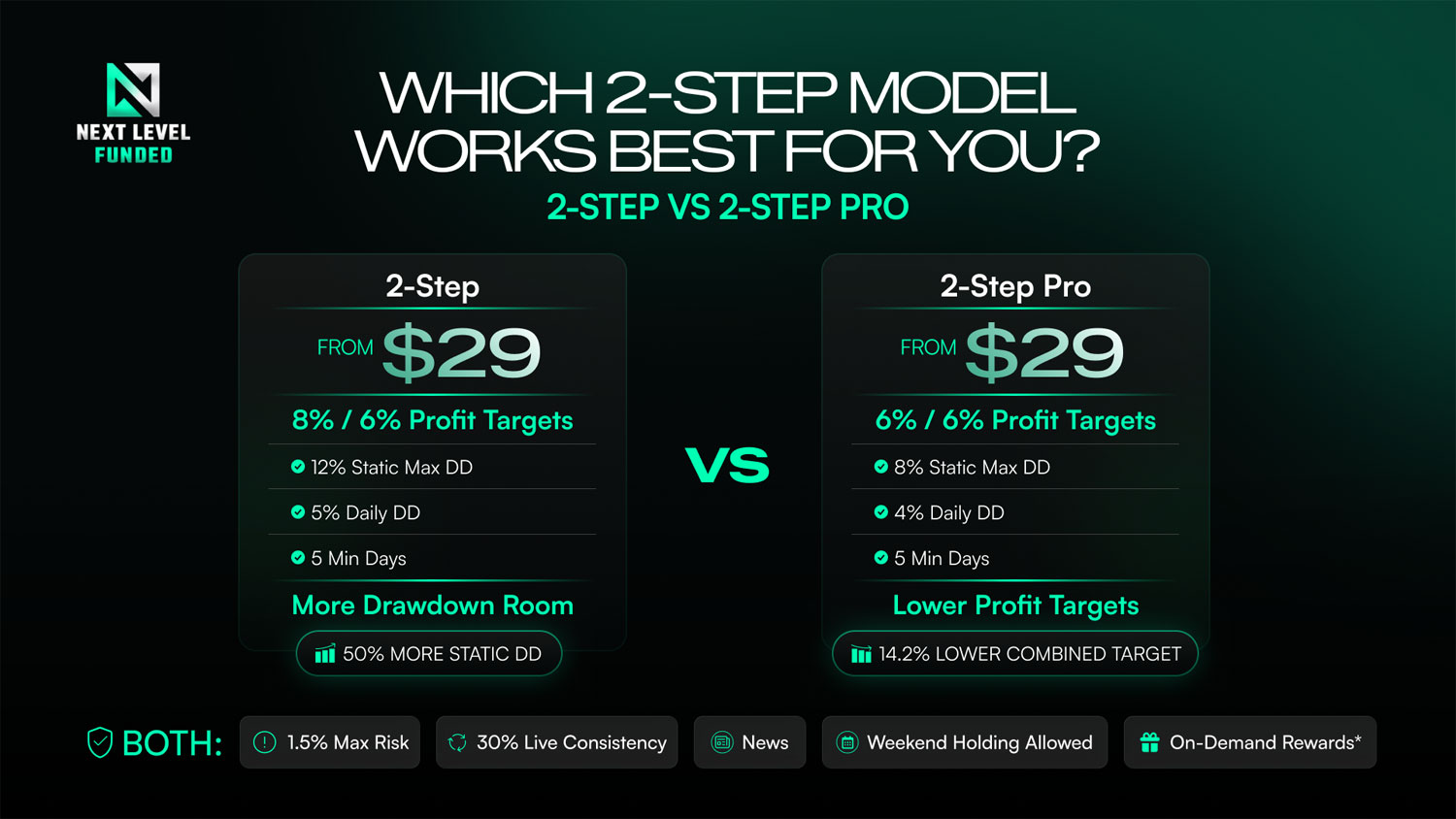
Next Level Funded offers two routes: 2-Step and 2-Step Pro. Both begin at the same $29 entry price and share the same core execution standards. The account you should choose comes down to one central trade-off:
- NLF 2-Step: More room to manage volatility, but a higher Phase 1 target.
- NLF 2-Step Pro: Lower target structure, but tighter daily and overall drawdown limits.
NLF 2-Step vs 2-Step Pro: Full Rules Comparison
*Rewards, reward splits, account eligibility, and reward timing are subject to NLF's current programme rules and review.[1]
The Fastest Way to Choose: More Drawdown Room or Lower Targets?
The two NLF models are priced the same. That makes the decision refreshingly clear.
The answer is not “the larger drawdown is always better” or “the lower target is always better.” A trader has to decide which pressure is more likely to damage their process: pressure from a smaller risk buffer or pressure from a higher target.
Choose NLF 2-Step If You Want More Room to Manage Risk
The standard NLF 2-Step model is built for traders who want the largest risk buffer in the NLF evaluation lineup. It uses an 8% Phase 1 target and 6% Phase 2 target, paired with a 12% static maximum drawdown and 5% daily drawdown.[1]
Its main advantage is not that you should use more drawdown. You should not. The advantage is that a strategy with normal volatility, wider stops, or multi-session holding has more room to move without forcing you to distort your execution.
Why 12% Static Maximum Drawdown Matters
Static maximum drawdown stays fixed rather than trailing upward as your account grows. This makes it easier for many traders to define a maximum loss plan before they enter the evaluation.
The standard 2-Step model has 50% more static drawdown room than 2-Step Pro: 12% compared with 8%. It also has 25% more daily drawdown room: 5% compared with 4%.
Who Should Choose 2-Step?
NLF 2-Step is often the stronger fit if you:
- Trade swing positions or use wider technical stop losses.
- Trade markets that naturally have larger intraday movement.
- Want the largest static maximum drawdown buffer available in NLF's evaluation models.
- Prefer 5% daily drawdown room over 4%.
- Are comfortable working toward an 8% Phase 1 target and 6% Phase 2 target.
- Would rather have more risk space than a lower Phase 1 target.
Choose NLF 2-Step Pro If You Want Lower Two-Phase Targets
The NLF 2-Step Pro model is built for traders who care most about reducing the profit objectives. It uses a 6% target in Phase 1 and a 6% target in Phase 2, for a 12% combined target.[1]
Compared with standard 2-Step's 8% / 6% structure, Pro reduces the total amount of target profit by two percentage points — a 14.2% lower combined target. The trade-off is the tighter risk envelope: 8% static maximum drawdown and 4% daily drawdown.
Why a Lower Target Can Be Useful
A lower Phase 1 target can help a trader remain patient. If the market does not produce clean setups, you do not have to manufacture an 8% result quickly. With unlimited maximum trading days on both models, the goal is not speed; it is clean execution across qualifying trading days.
Who Should Choose 2-Step Pro?
NLF 2-Step Pro is often the stronger fit if you:
- Value a lower 6% Phase 1 target.
- Prefer two equal 6% phase objectives.
- Have a disciplined, low-risk strategy that can operate comfortably inside 4% daily and 8% static drawdown limits.
- Want a lower combined target without paying more than standard 2-Step.
- Do not need the larger 12% / 5% risk buffer of the regular 2-Step model.
What Both Two-Step Models Have in Common
Your account selection should not ignore the shared rules. Both 2-Step and 2-Step Pro require the same core execution discipline.
How to Select the Right Model Using Your Trading Journal
Do not choose based on the best result you have ever posted in a demo account. Use a realistic sample of your most recent trades.
Choose the account that works after a normal losing week, not the one that looks easiest before you take a trade.
Example Decision Scenarios
Scenario 1: The Swing Trader Who Needs a Larger Buffer
You hold trades over multiple sessions, use structure-based stops, and expect controlled pullbacks before a position develops. You do not want to take more risk; you simply need room for the risk your strategy already requires.
Best fit: NLF 2-Step. The 12% static maximum drawdown and 5% daily drawdown provide the broader risk framework.
Scenario 2: The Highly Selective Intraday Trader
You take only a few A+ setups every week. Your stops are tight, your risk per trade is usually well below 1.5%, and a lower Phase 1 target helps you avoid forcing trades.
Best fit: NLF 2-Step Pro. The 6% / 6% target structure may be a better match, provided you are comfortable with the 8% static maximum and 4% daily drawdown limits.
Scenario 3: The Trader Who Has Failed Challenges on One Bad Day
You may be profitable over time, but your worst mistake is letting one losing session expand. A larger daily drawdown number does not solve that behaviour — but the larger overall and daily limits can provide more space while you improve risk discipline.
Best fit: Usually NLF 2-Step. However, the core solution is reducing risk and respecting the 1.5% maximum per trade, not treating the 5% daily drawdown as a target to use.
Scenario 4: The Trader Who Wants the Same Price but a Lower Goal
You do not need a wide swing-trading buffer. You want to start at the same $29 price but prefer a 6% first phase rather than an 8% first phase.
Best fit: NLF 2-Step Pro. The lower targets are the central reason to choose it.
Frequently Asked Questions: NLF 2-Step vs 2-Step Pro
Which NLF 2-Step model has the lower profit target?
NLF 2-Step Pro has 6% / 6% targets. Standard NLF 2-Step has 8% / 6% targets.[1]
Which account has more maximum drawdown room?
Standard NLF 2-Step lists a 12% static maximum drawdown, compared with 8% static maximum drawdown on 2-Step Pro. That is 50% more overall drawdown room.[1]
Which account has a higher daily drawdown?
Standard NLF 2-Step lists a 5% daily drawdown. NLF 2-Step Pro lists a 4% daily drawdown.[1]
Do 2-Step and 2-Step Pro cost the same?
Both current models start at $29. Verify the live page before purchasing because pricing and promotions can change.[1]
Are news and weekend holding allowed on both models?
The current supplied rules list news holding and weekend holding as allowed on both 2-Step models.[1]
Can I use an EA or copy-trading service on NLF 2-Step accounts?
No. The current rules list copy trading and EAs as not allowed on both 2-Step and 2-Step Pro.[1]
Do the NLF two-step models have a time limit?
Both models list unlimited maximum trading days. Both require five minimum trading days.[1]
Final Verdict: Which NLF 2-Step Model Is Best for You?
Choose NLF 2-Step if your top priority is drawdown room. It gives you a 12% static maximum drawdown and 5% daily drawdown, both larger than the Pro model, for the same $29 starting price. It is particularly suitable for disciplined traders whose style involves wider stops, swing positions, or normal market volatility.
Choose NLF 2-Step Pro if your top priority is a lower profit objective. Its 6% / 6% structure reduces the combined target from 14% to 12%, while keeping the same $29 starting price, unlimited maximum trading days, five minimum days, and shared NLF execution rules. It is best for traders who can stay comfortably inside an 8% static maximum drawdown and 4% daily drawdown.
Both models reward a disciplined plan. Choose the version that lets you respect your risk rules, wait for quality setups, and complete each phase without forced trading.
Compare NLF 2-Step and 2-Step Pro Accounts
References
[1] Next Level Funded, Trading Evaluations and Current 2-Step Account Rules; NLF 2-Step vs 2-Step Pro rules table supplied by Next Level Funded.
Author: Spencer Todd, Founder of Next Level Funded
Trading involves risk. NLF provides simulated trading services. This article is educational and promotional, not financial or investment advice. Account rules, fees, reward terms, and eligibility are subject to the current NLF programme terms and review. No trading outcome, account approval, reward, or payout is guaranteed.
More Blogs


October 9, 2026
Free $10K Instant Funded Account: Here's How to Get One With Next Level Funded
Read Story
September 26, 2026
Best Prop Firm Affiliate Program 2026 - Free $10K Instant Funded Account
Read StorySTART TRADING WITH CLEAR RULES
Choose from 1-step, 2-step and instant funding models across CFDs and forex, built around your trading style.
Get Started Now
© Next Level Funded 2026 | All Rights Reserved


