


.svg)


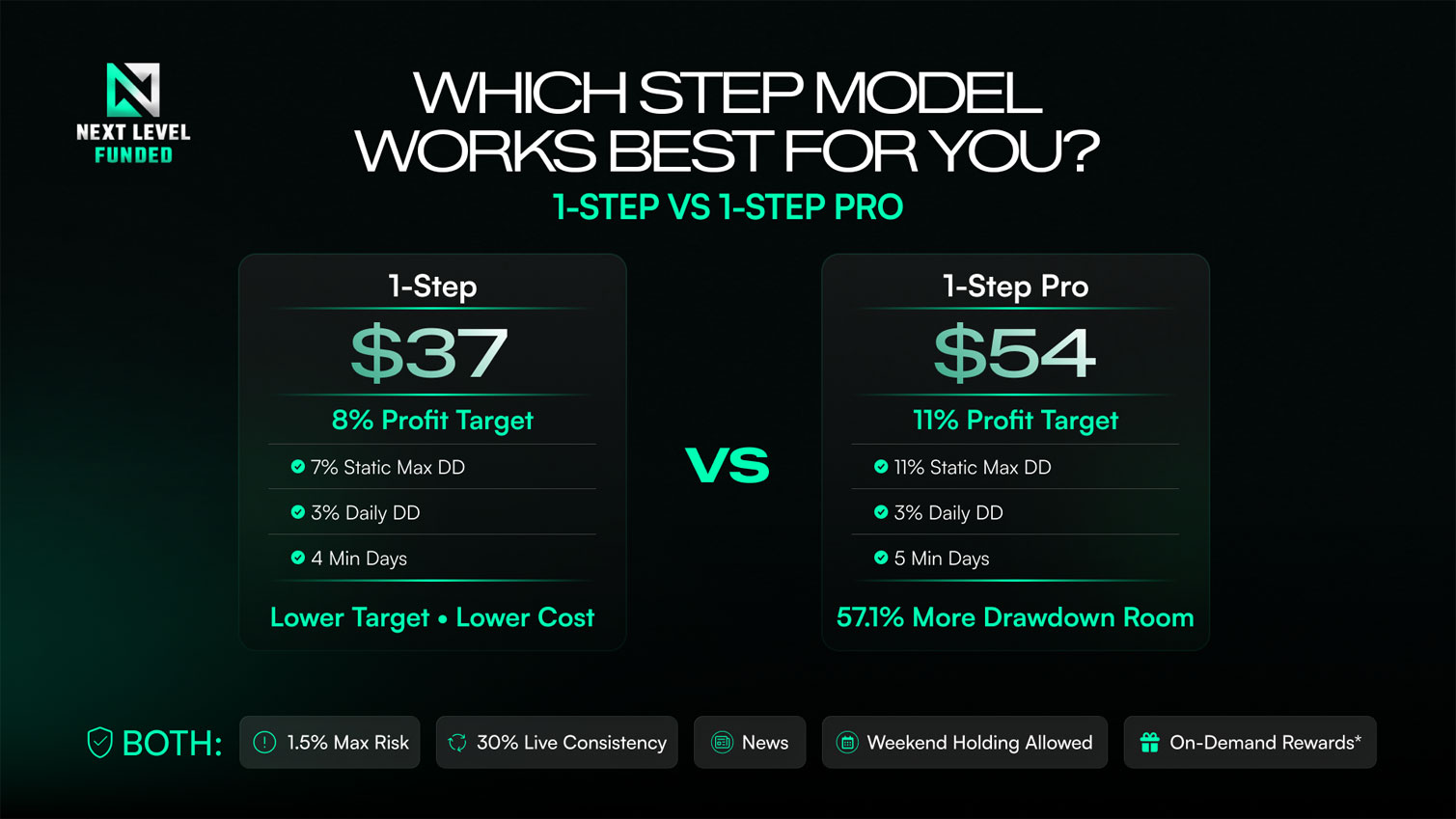
Both are one-phase evaluation accounts. Both give you unlimited maximum trading days and a fixed, static maximum drawdown. Both are designed for traders who want a clear evaluation route with up to a 100% rewards split and on-demand reward cycle, subject to current programme terms.[1]
The difference is strategic:
- 1-Step asks for a smaller 8% profit target and starts at $37, but gives you a 7% static maximum drawdown.
- 1-Step Pro asks for an 11% profit target and starts at $54, but gives you an 11% static maximum drawdown.
In simple terms, 1-Step is the lower-target, lower-cost route. 1-Step Pro is the larger-buffer route.
NLF 1-Step vs 1-Step Pro: Full Rules Comparison
*Rewards, reward splits, account eligibility, and reward timing are subject to NLF's current programme rules and review.[1]
The Key Decision: 8% Target or 11% Static Drawdown?
The profit target and drawdown buffer need to be viewed together. Looking only at the profit target can be misleading, because traders do not execute inside a spreadsheet. They execute through losses, pullbacks, missed setups, variable volatility, and real-time decision pressure.
Choose NLF 1-Step If You Want the Lower 8% Profit Target
The regular NLF 1-Step account is best for a trader who wants the most direct one-phase route at the lower starting price.
Its defining advantage is the 8% profit target. A lower target can make it easier to plan a measured route through the evaluation. You may prefer 1-Step if your strategy is built around shorter holding periods, frequent opportunities, or a steady daily target that does not require a large cumulative return.
The Current 1-Step Profile
Who Is 1-Step Best For?
NLF 1-Step is generally the better choice if you:
- Want the lowest-cost one-step evaluation entry.
- Prefer an 8% target over an 11% target.
- Have a strategy with reasonably tight stops and a controlled average loss.
- Trade frequently enough to complete four qualifying trading days without forcing trades.
- Value a direct route but do not need an unusually wide overall drawdown buffer.
The 7% static drawdown is not “small” or “large” in isolation. It is appropriate only if it fits your normal trade risk, your stop distance, and your ability to stop after a losing sequence.
Choose NLF 1-Step Pro If You Need More Static Drawdown Room
The NLF 1-Step Pro account is the better fit for traders who value trading space more than the smallest possible profit target.
The model asks for an 11% profit target, but the 11% static maximum drawdown changes how the account feels in practice. Compared with the standard 7% static drawdown, Pro gives you four additional percentage points of room — a 57.1% larger overall drawdown buffer.
Why a Larger Static Buffer Can Be Valuable
A static drawdown does not trail upward with your account's highest profit level. The reference boundary stays fixed. That makes it easier for many traders to plan maximum risk, especially traders who hold positions longer or use wider technical invalidation levels.
The larger 11% static drawdown on 1-Step Pro can be helpful for a trader who:
- Uses wider stops to avoid routine market noise.
- Trades higher-volatility sessions or instruments.
- Holds swing ideas over multiple sessions.
- Needs extra room for normal drawdown while a strategy develops.
- Would rather work toward a larger 11% target than feel pressured by a tighter 7% maximum drawdown.
Who Is 1-Step Pro Best For?
NLF 1-Step Pro is generally the better choice if you:
- Use a swing or position-trading approach.
- Need more room for wider stops and normal price fluctuation.
- Can commit to a five-day minimum instead of four.
- Are comfortable pursuing an 11% target.
- Prefer a target-to-drawdown framework of 11% target / 11% static drawdown.
What Both NLF Step Models Have in Common
The target and maximum drawdown are different, but the core execution standards are shared. This matters because you should not choose Pro merely because it has more overall drawdown room, then ignore the rules that are identical on both accounts.
A Practical Way to Decide: Use Your Normal Risk, Not Your Best Month
Before you purchase either model, use a realistic sample of recent trades. Do not choose based on your best week or the results you believe you “should” achieve. Review your typical behaviour.
The right model is the one you can follow after two losing trades, not the one that looks best before your first trade.
Example Decision Scenarios
Scenario 1: The Intraday Trader with a Tight Risk Plan
You trade one or two sessions per day. Your stops are controlled, your average risk is well below the 1.5% maximum, and you prefer taking a modest number of repeatable setups. You do not need a large swing buffer. You want the smaller target and lower price.
Best fit: NLF 1-Step. The 8% target, 7% static maximum drawdown, $37 entry price, and four minimum days create a direct route that fits this controlled style.
Scenario 2: The Swing Trader Who Needs Room to Breathe
You trade less frequently, hold positions through sessions, and allow reasonable pullbacks when structure remains valid. You understand that wider drawdown room does not mean permission to take more risk. You want the 11% static maximum drawdown so you can respect a properly placed stop rather than reduce it simply to fit a tighter account limit.
Best fit: NLF 1-Step Pro. The 11% static maximum drawdown is the defining advantage, balanced against the 11% target and five minimum days.
Scenario 3: The Beginner Who Is Not Yet Certain
You are still learning whether you can follow a daily loss limit, stop-loss rule, and one-phase evaluation process. You care more about simple targets and keeping costs lower than having the largest possible drawdown room.
Best fit: Usually NLF 1-Step. Start with the simpler 8% target and lower entry price only if you can genuinely work within the 7% static maximum drawdown. If your current strategy requires wider stops, develop and test it before buying either model.
Frequently Asked Questions: NLF 1-Step vs 1-Step Pro
Which NLF step model has the lower profit target?
The standard NLF 1-Step account has an 8% profit target. NLF 1-Step Pro has an 11% profit target.[1]
Which model has the largest maximum drawdown?
NLF 1-Step Pro lists an 11% static maximum drawdown, compared with 7% static maximum drawdown on standard 1-Step.[1]
Is 1-Step Pro easier because it has an 11% maximum drawdown?
Not automatically. Pro gives a larger static drawdown buffer, but it also has a higher 11% profit target and five minimum trading days. “Easier” depends on whether that target-to-drawdown relationship fits your trading method.
Do both NLF models have the same daily drawdown?
Yes. Both the 1-Step and 1-Step Pro models list a 3% daily drawdown.[1]
Can I hold trades through news or the weekend?
The current rules table lists both news holding and weekend holding as allowed on 1-Step and 1-Step Pro.[1]
Can I use copy trading or an EA?
No. The current supplied rules list copy trading and EAs as not allowed on either 1-Step model.[1]
Do 1-Step and 1-Step Pro have a time limit?
Both models list unlimited maximum trading days. They do have separate minimum trading-day requirements: four days on 1-Step and five days on 1-Step Pro.[1]
Final Verdict: Which NLF Step Model Is Best for You?
Choose NLF 1-Step if you want the more accessible one-phase route: an 8% target, $37 starting price, four minimum trading days, and a 7% static maximum drawdown.
Choose NLF 1-Step Pro if your strategy needs more room. The 11% static maximum drawdown is 57.1% larger than the standard model's 7% buffer, and that space can be valuable for disciplined swing traders, wider-stop approaches, and traders who would rather work toward an 11% target than force their strategy into a tighter risk envelope.
Neither model rewards reckless risk. Both require the same 3% daily drawdown discipline, 1.5% maximum risk per trade, stop-loss rule, and two-minute rule. Select the model that allows you to execute the plan you already have — calmly, consistently, and without forcing trades.
Compare NLF 1-Step and 1-Step Pro Accounts
References
[1] Next Level Funded, Trading Evaluations and Current 1-Step Account Rules; NLF 1-Step vs 1-Step Pro rules table supplied by Next Level Funded.
Author: Spencer Todd, Founder of Next Level Funded
Trading involves risk. NLF provides simulated trading services. This article is educational and promotional, not financial or investment advice. Account rules, fees, reward terms, and eligibility are subject to the current NLF programme terms and review. No trading outcome, account approval, reward, or payout is guaranteed.
More Blogs


October 9, 2026
Free $10K Instant Funded Account: Here's How to Get One With Next Level Funded
Read Story
September 26, 2026
Best Prop Firm Affiliate Program 2026 - Free $10K Instant Funded Account
Read StorySTART TRADING WITH CLEAR RULES
Choose from 1-step, 2-step and instant funding models across CFDs and forex, built around your trading style.
Get Started Now
© Next Level Funded 2026 | All Rights Reserved


