


.svg)


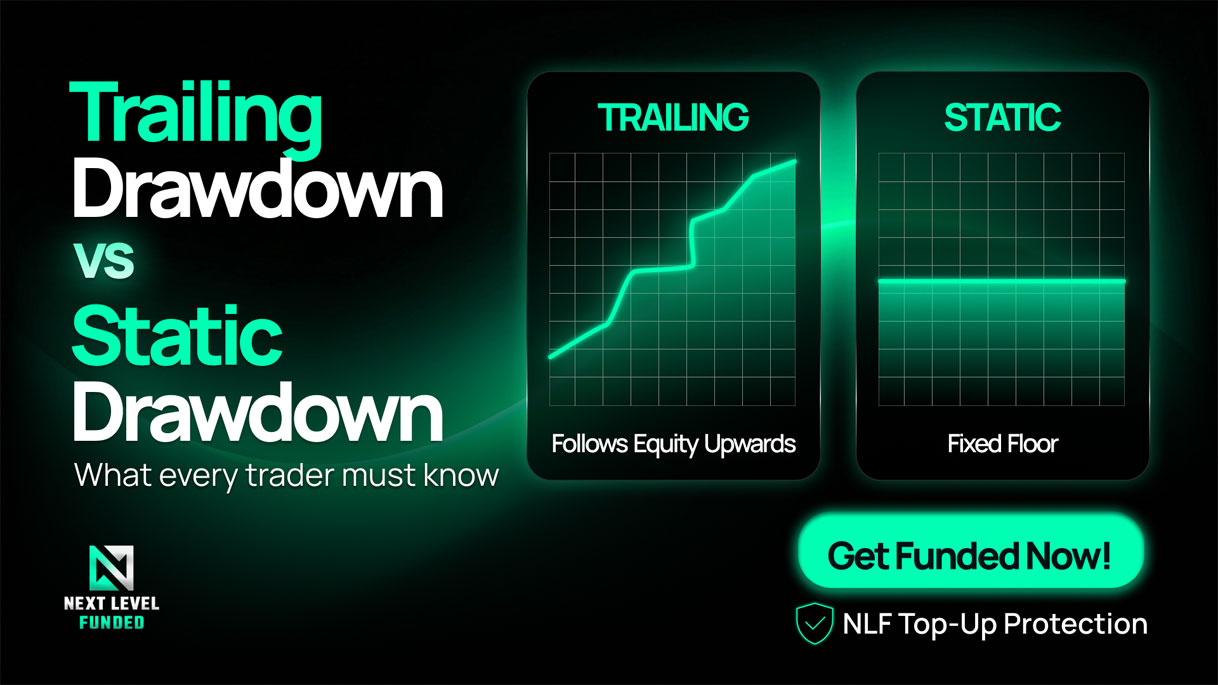
In 2026, prop firms use two primary methods to track your risk: trailing drawdown and static drawdown. Choosing the wrong type for your trading strategy is a guaranteed path to failure.
Quick Summary: Static vs Trailing Drawdown Static drawdown sets a fixed floor based on your initial account balance that never moves (e.g., $90,000 floor on a $100K account). Trailing drawdown moves up as your account equity grows, constantly shrinking your buffer. While static drawdown is easier to manage, trailing drawdown allows firms to offer larger capital allocations and instant funding. Next Level Funded (NLF) solves the trailing drawdown trap by offering a unique Top-Up Feature, allowing you to rescue your account instead of losing it forever.
Below, we break down the exact math behind both drawdown types, how they impact your psychology, and how to protect your funded status.
What is Static Drawdown?
Static drawdown is the simplest and most forgiving risk model. The maximum loss limit is calculated from your starting balance and remains fixed, regardless of how much profit you generate.
The Math Behind Static Drawdown
Imagine you purchase a $100,000 funded account with a 10% static overall drawdown limit.
- Your maximum loss limit is set at $90,000.
- If your account balance drops below $90,000 at any point, you lose the account.
The Advantage: As you generate profit, your buffer increases. If you grow your account to $110,000, your drawdown limit remains at $90,000. You now have a massive $20,000 buffer to trade with.
The Disadvantage: Because this model is highly favorable to the trader, firms that offer static drawdown (like FTMO) almost always require you to pass a strict, multi-phase evaluation before they will give you a live account.
What is Trailing Drawdown?
Trailing drawdown is far more complex. Instead of a fixed floor, the drawdown limit "trails" your account equity as it grows. There are two variations of trailing drawdown:
- End-of-Day (EOD) Trailing: The drawdown is calculated based on your balance at the end of the trading day.
- Intraday Trailing: The drawdown is calculated based on your highest unrealized profit during an active trade. This is notoriously difficult to manage, as a winning trade that pulls back before hitting your take-profit can trigger a failure.
The Math Behind Trailing Drawdown
Imagine you purchase a $50,000 account with a $2,000 trailing drawdown limit.
- Your initial loss limit is set at $48,000.
- If you make $1,000 in profit, your balance is $51,000. Your trailing drawdown moves up by $1,000. Your new loss limit is $49,000.
- Your buffer remains exactly $2,000, regardless of how much profit you make.
The Advantage: Firms that use trailing drawdowns are often willing to offer Instant Funding without requiring an evaluation phase, as the firm's capital is tightly protected.
The Disadvantage: Early profits create a false sense of security. If you go on a winning streak and then hit a normal string of losses, the trailing floor will catch up to you and terminate your account.
The Ultimate Solution: The Next Level Funded Top-Up Feature
For years, traders have been forced to choose between the safety of static drawdown (which requires passing a grueling evaluation) or the speed of trailing drawdown (which is highly restrictive).
In 2026, Next Level Funded has completely changed the math.
NLF offers an Instant Pro account with a 6% trailing drawdown. However, they have eliminated the psychological trap of trailing drawdowns by introducing the revolutionary Top-Up Feature.
How the Top-Up Feature Saves Your Account
At legacy futures firms (like FTMO or FundedNext), if you breach your trailing drawdown by even a single tick, your account is permanently closed. You lose all your progress and must pay a reset fee to start a brand new evaluation from scratch.
At Next Level Funded, if your account dips into a drawdown, you are not punished with permanent failure. You have the ability to simply top up your account with more funds. This pushes your equity back above the trailing floor, keeping you in the game and protecting your funded status.
Conclusion: Master Your Drawdown
Understanding the difference between static and trailing drawdown is the first step to becoming a consistently profitable prop trader.
While static drawdown offers a larger buffer, it forces you to trade simulated funds for months. Trailing drawdown offers instant access to capital, but the risk of failure is high.
By offering Instant Funding, a 100% profit split, and the safety net of the Top-Up Feature, Next Level Funded provides the ultimate environment for serious traders to scale their capital without fear.
Click here to get Instant Funding with Next Level Funded and trade with confidence today.
About the Author
Spencer is the Founder and CEO of Next Level Funded. His journey in the financial markets began in May 2019, trading cryptocurrency. By October 2022, Spencer had successfully navigated the prop firm industry, becoming a fully funded trader and securing consistent payouts. After years of experiencing the disconnect and restrictive rules of legacy prop firms, he established Next Level Funded in December 2024 to create a transparent, trader-first environment. Today, Spencer runs NLF operations and actively livestreams to a community of over 11,000 traders, sharing his expertise and passion for making capital accessible to talent worldwide.
More Blogs


September 12, 2026
Can You Have Multiple NLF Instant Flex Accounts? $10K Limits, Larger Account Options & $500K Cap Explained
Read Story
September 8, 2026
Best $10K Instant Funded Account for Beginners? NLF Instant Flex Rules, Price and Payout Limit
Read Story© Next Level Funded 2026 | All Rights Reserved


