


.svg)


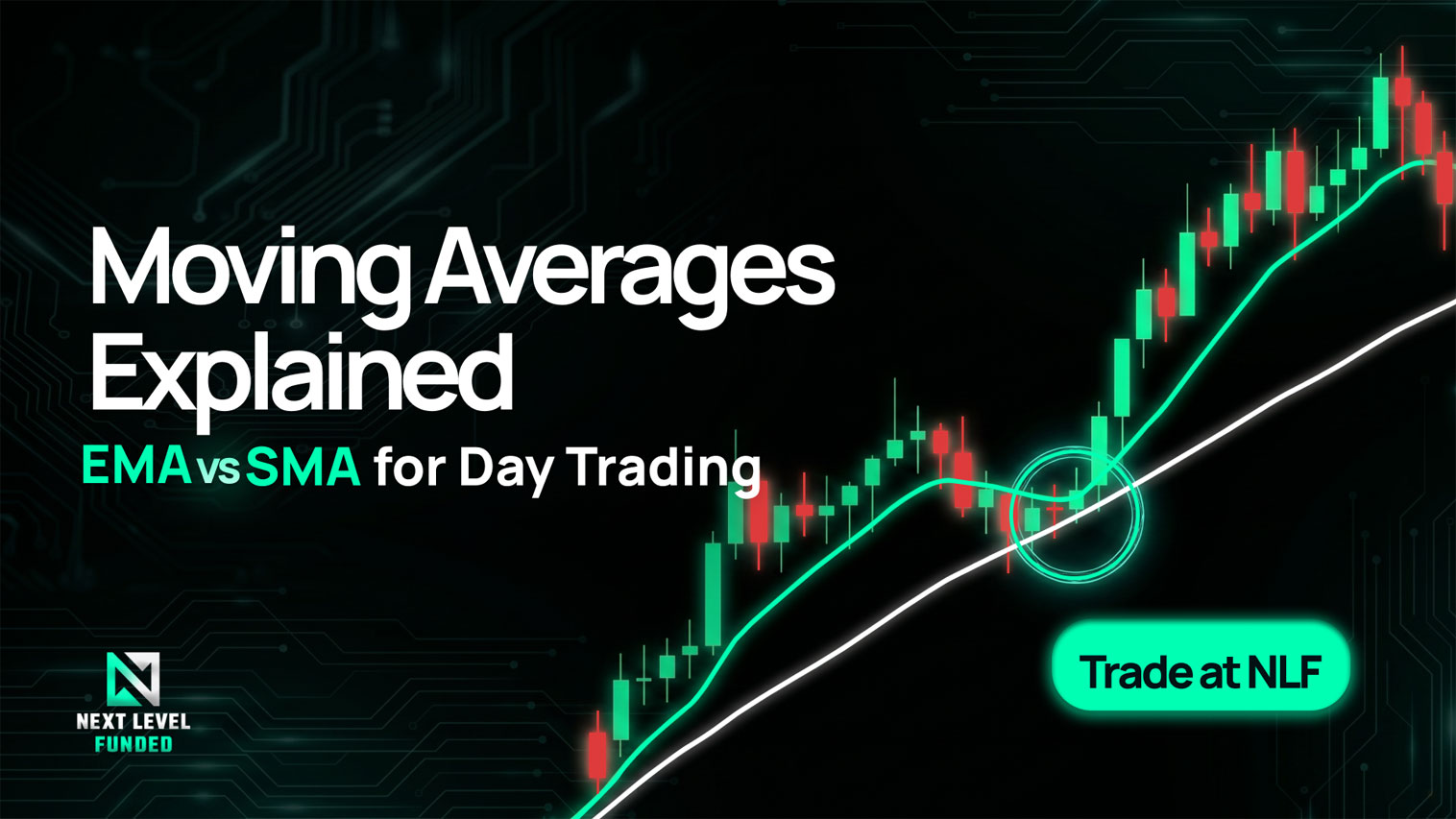
Whether you are trading forex, futures, or indices, moving averages are arguably the most universally used technical indicators in the world. They smooth out chaotic price action and provide a clear, visual representation of the market's trend.
However, a common dilemma for new traders, especially those preparing for a prop firm challenge, is choosing between the Simple Moving Average (SMA) and the Exponential Moving Average (EMA).
While both indicators appear as a single line on your chart, the mathematics behind them tells two entirely different stories about price action. In this guide, we will break down the core differences between EMA vs SMA, explain which one is better for day trading, and provide the best settings to pass your Next Level Funded evaluation.
What is a Simple Moving Average (SMA)?
The Simple Moving Average (SMA) is exactly what its name implies: simple. It calculates the average closing price of an asset over a specified number of periods.
For example, a 50-period SMA on a daily chart adds up the closing prices of the last 50 days and divides that number by 50. Every single day in that calculation carries the exact same mathematical weight. The price action from 49 days ago is treated as equally important as the price action from yesterday.
The Pros and Cons of the SMA
- Pros: Because it is slow and smooth, the SMA is excellent at filtering out short-term "noise" and fakeouts. It provides a highly reliable picture of the overarching macro trend.
- Cons: Because it gives equal weight to old data, the SMA suffers from significant "lag." By the time the SMA changes direction to signal a trend reversal, the move has often already happened.
What is an Exponential Moving Average (EMA)?
The Exponential Moving Average (EMA) was designed specifically to address the lagging nature of the SMA. While it still calculates an average over a set period, the EMA applies a mathematical multiplier that places greater weight on the most recent price data.
If a sudden news event causes a massive spike in price today, the EMA will react and angle upwards much faster than the SMA, because today's price carries more weight than the price from 20 days ago.
The Pros and Cons of the EMA
- Pros: The EMA is highly responsive. It hugs the price action closely, allowing day traders to spot momentum shifts and enter trades much earlier than they could with an SMA.
- Cons: Because it is so sensitive to recent price changes, the EMA is prone to "whipsaws." A sudden, temporary spike in price might cause the EMA to signal a reversal, only for the price to immediately resume its original trend, faking out the trader.
EMA vs SMA: Which is Better for Day Trading?
The debate between EMA vs SMA comes down entirely to your trading style and timeframe.
For Day Traders and Scalpers: The EMA is universally considered the superior choice. When you are trading on the 1-minute or 5-minute chart, you need indicators that react instantly to order flow and momentum shifts. The lag of an SMA will cause you to enter trades too late and miss the bulk of the intraday move.
For Swing Traders and Investors: The SMA is generally preferred. If you are holding positions for weeks or months, you do not want to be faked out by daily volatility. The 50-day and 200-day SMAs are institutional standards for determining long-term bull or bear markets.
The Best Moving Average Settings for Prop Trading
To pass a prop firm challenge, you need a strategy that balances responsiveness with reliability. Many successful funded traders use a combination of both moving averages.
A Common Day Trading Strategy: Plot the 9 EMA and the 20 EMA on a 5-minute chart. When the 9 EMA crosses above the 20 EMA, it signals a bullish momentum shift. Traders will then look for price action confirmation (like a bullish engulfing candle) to enter long, using the 20 EMA as dynamic support.
Execute Your Strategy with Professional Capital
Understanding the difference between an EMA and an SMA is a crucial step in mastering technical analysis. But even the best moving average crossover strategy is useless if you do not have the capital to trade it effectively.
At Next Level Funded, we provide the capital you need to turn your technical edge into a full-time income. Whether you use a fast 9 EMA to scalp the open or a slow 50 SMA to swing trade forex pairs, our evaluation parameters are designed to support your style.
Stop risking your own money on small personal accounts. Prove your edge, manage your risk, and trade up to $200,000 in funded capital with the industry's most trader-friendly prop firm.
More Blogs

September 12, 2026
Can You Have Multiple NLF Instant Flex Accounts? $10K Limits, Larger Account Options & $500K Cap Explained
Read Story
September 8, 2026
Best $10K Instant Funded Account for Beginners? NLF Instant Flex Rules, Price and Payout Limit
Read Story© Next Level Funded 2026 | All Rights Reserved


