


.svg)


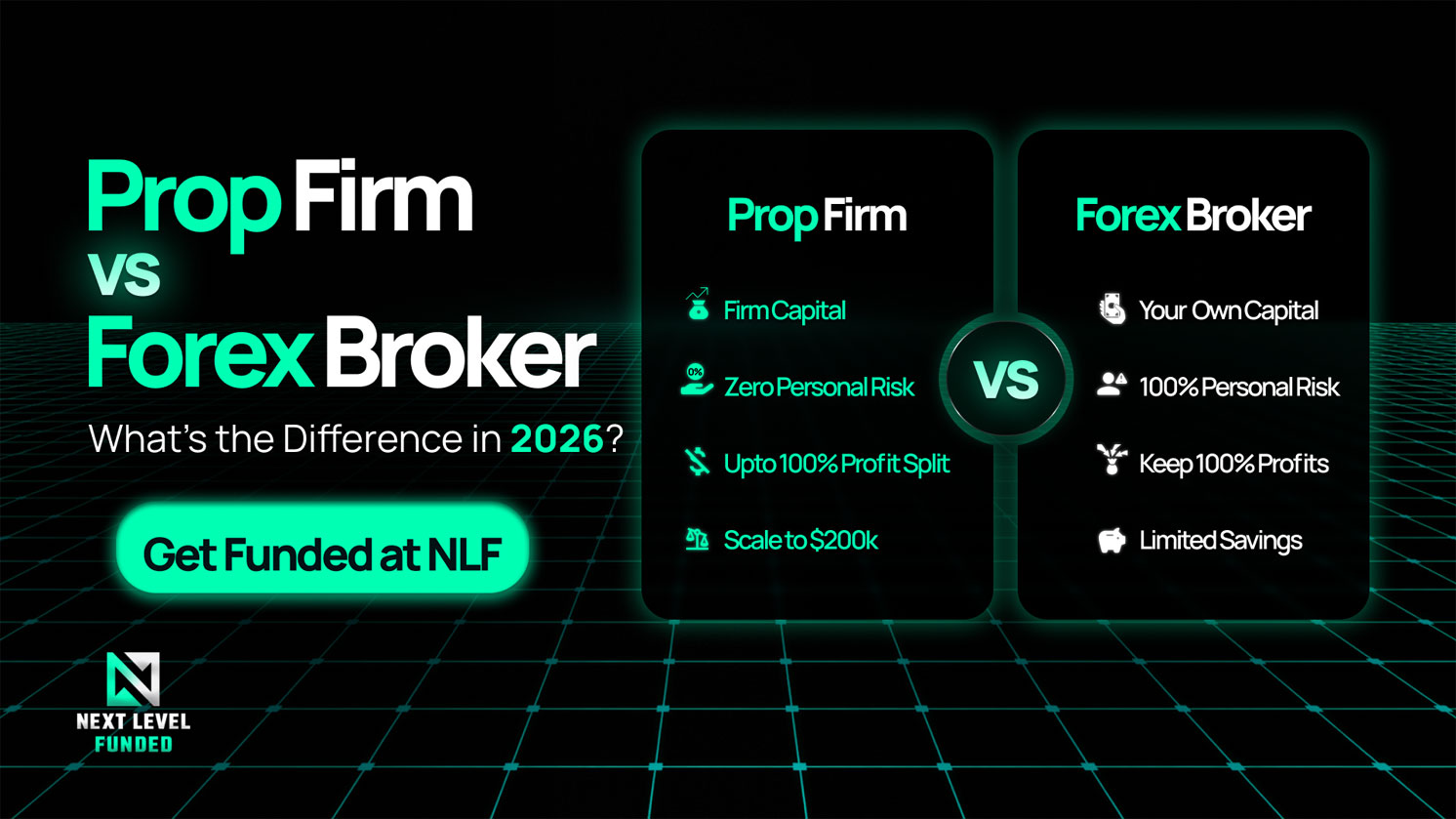
The retail trading industry has undergone a massive transformation over the last five years. In 2026, the traditional path of saving up a few thousand dollars to open a personal brokerage account is rapidly being replaced by the proprietary trading model.
For new traders, the terminology can be confusing. Both entities provide access to trading platforms, both offer leverage, and both allow you to trade forex, indices, and commodities.
So, what exactly is the difference between a prop firm and a forex broker, and which one is the better choice for your trading career?
In this comprehensive breakdown, we will analyze the legal, financial, and structural differences between the two models and explain why trading with a prop firm like Next Level Funded is the optimal path for scaling your income.
What is a Forex Broker?
A retail forex broker is a financial services company that provides traders with access to a platform for buying and selling foreign currencies.
Brokers act as the middleman between you (the retail trader) and the interbank market (the network of banks that trade currencies with each other).
How a Broker Works:
- Your Capital: You must deposit your own personal money into the brokerage account to start trading.
- Your Risk: You assume 100% of the financial risk. If you lose a trade, the money is deducted directly from your personal bank account.
- Your Profits: You keep 100% of the profits you generate.
- The Broker's Revenue: The broker makes money primarily through spreads (the difference between the buy and sell price), commissions on each trade, and overnight financing fees (swaps). In the case of "B-Book" brokers, they may also act as the counterparty to your trades, meaning they profit when you lose.
What is a Prop Firm?
A proprietary trading firm (prop firm) is a company that provides professional traders with access to the firm’s own capital to trade the financial markets.
Instead of acting as a middleman, the prop firm is essentially hiring you as an independent contractor to manage their money.
How a Prop Firm Works:
- Firm Capital: You do not deposit your own money to trade. The firm provides the capital (e.g., a $100,000 funded account).
- The Firm's Risk: The firm assumes all the downside risk. If you lose money on the funded account (within the agreed-upon drawdown limits), you are not personally liable for the losses. The worst-case scenario is that you lose access to the account.
- Profit Split: You split the profits with the firm. At Next Level Funded, traders keep up to 100% of their profits on select accounts, with standard splits starting at 80%.
- The Evaluation Phase: To access the firm's capital, you must first prove you are a profitable trader by passing an evaluation (a simulated trading challenge with specific profit targets and risk rules). You pay a small upfront fee to take this challenge, which is typically refunded when you receive your first payout.
Prop Firm vs Forex Broker: Key Differences
To determine which model is right for you, we must compare them across three critical dimensions: Risk, Capital, and Freedom.
The Verdict: Which is Better?
If you are a wealthy individual with $100,000 in disposable income that you are willing to risk, a retail forex broker offers total freedom. You can trade without drawdown limits, hold positions indefinitely, and keep every penny you make.
However, for the vast majority of retail traders in 2026, the prop firm model is vastly superior.
The biggest hurdle for retail traders is undercapitalization. If you only have $1,000 to trade with, even a stellar 10% monthly return only yields $100. This often leads traders to overleverage their small accounts in an attempt to make meaningful money, which inevitably results in blown accounts.
By paying a small, refundable fee (often under $100) to take a prop firm challenge, you gain access to professional-sized capital. That same 10% return on a $100,000 funded account yields $10,000 in gross profit. Even after an 80% profit split, you take home $8,000—all without risking your personal savings.
Why Next Level Funded is the Ultimate Prop Firm
While the prop firm model is superior to retail brokerage, not all prop firms are created equal.
At Next Level Funded, we have designed our infrastructure to align perfectly with the success of our traders. We do not profit from your failure; we profit from your payouts.
- Instant Funding: Bypass the evaluation phase entirely and start trading live capital for as little as $10.
- Industry-Leading Splits: Keep up to 100% of your profits on select accounts.
- On-Demand Payouts: Get paid weekly, directly to your crypto wallet or bank account.
- Massive Scaling: Prove your consistency and scale your trading capital up to $200,000.
Stop risking your own hard-earned money on a retail broker. Leverage our capital, manage your risk, and start treating trading like a professional business.
More Blogs


September 12, 2026
Can You Have Multiple NLF Instant Flex Accounts? $10K Limits, Larger Account Options & $500K Cap Explained
Read Story
September 8, 2026
Best $10K Instant Funded Account for Beginners? NLF Instant Flex Rules, Price and Payout Limit
Read Story© Next Level Funded 2026 | All Rights Reserved


