


.svg)


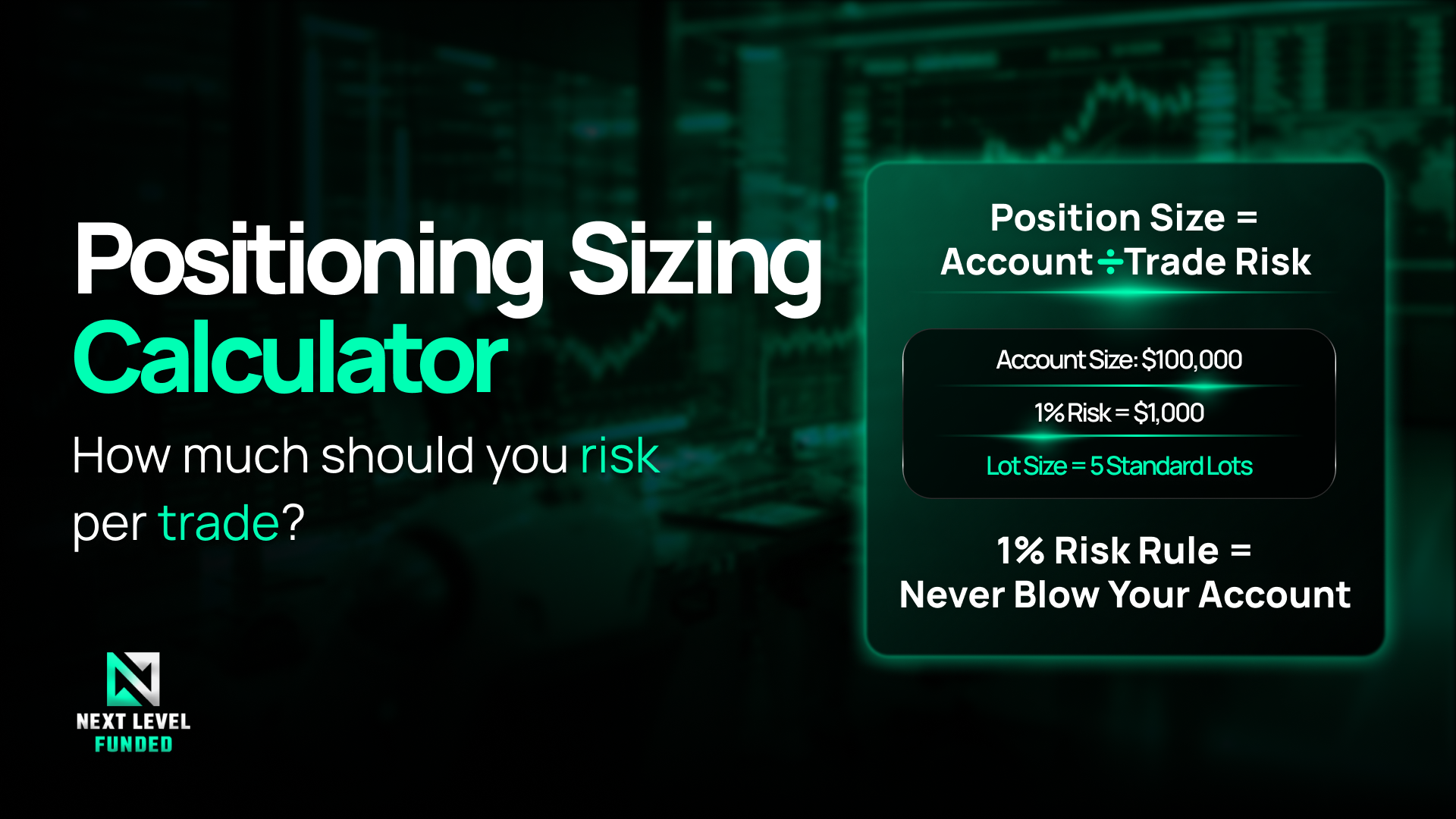
If you ask 100 failed traders why they blew their accounts, 99 of them will give you the same answer: they risked too much on a single trade.
In the proprietary trading industry, your ability to predict the market is secondary to your ability to manage risk. You can have a strategy with a 60% win rate, but if you do not understand how to use a position sizing calculator, one bad losing streak will wipe you out.
In this guide, we will break down the exact mathematical formula professional traders use to calculate their lot size, explain the golden "1% Risk Rule," and show you how to apply this to a Next Level Funded evaluation to guarantee you never hit your daily drawdown limit.
What Is Position Sizing?
Position sizing is the process of determining exactly how many shares, contracts, or lots you should buy or sell on a specific trade to ensure your maximum potential loss aligns with your risk management rules.
Instead of guessing ("I'll just trade 1 lot and see what happens"), a position sizing calculator tells you precisely what lot size to use based on the distance to your Stop Loss.
The Golden Rule: The 1% Risk Rule
The foundation of professional position sizing is the 1% Risk Rule. This rule states that you should never risk more than 1% to 2% of your total account capital on any single trade.
Why 1%? Because of the mathematics of drawdowns. If you risk 1% per trade and lose 5 trades in a row, your account is down 5%. You are still in the game. If you risk 5% per trade and lose 5 trades in a row, your account is down 25%. Psychologically and mathematically, recovering from a 25% drawdown is incredibly difficult.
The Position Sizing Formula
At its core, the formula for calculating your position size is simple [4]:
Position Size = Account Risk ÷ Trade Risk (Distance to Stop Loss)
Let's break this down into three steps:
Step 1: Calculate Your Account Risk
Determine how much money represents 1% of your total account balance.
- Account Size: $100,000 (NLF Pro Account)
- Risk Percentage: 1%
- Account Risk: $1,000
If this trade hits your Stop Loss, you will lose exactly $1,000.
Step 2: Determine Your Trade Risk (Stop Loss Distance)
Look at your chart and identify the logical place for your Stop Loss (e.g., below a recent swing low). Calculate the distance from your entry price to that Stop Loss.
- Let's say you are trading EUR/USD, and your Stop Loss is 20 pips away.
Step 3: Calculate the Lot Size
Now, you need to find the lot size where 20 pips equals exactly $1,000.
- In Forex, 1 Standard Lot ($100,000 units) equals roughly $10 per pip.
- If you trade 1 Lot, a 20-pip loss = $200.
- To reach your $1,000 risk limit: $1,000 ÷ $200 = 5 Lots.
Your precise position size for this trade is 5 Standard Lots.
How Position Sizing Saves Your Prop Firm Challenge
When you trade with a prop firm, you are bound by strict drawdown limits. At Next Level Funded, our standard evaluations feature a 5% Daily Drawdown and a 10% Overall Drawdown.
If you do not use a position sizing calculator, you are trading blind. If you accidentally risk 3% on a trade and lose two in a row, you have breached your daily drawdown limit and lost your account.
By strictly adhering to the 1% risk rule and calculating your position size on every single trade, you mathematically guarantee that you can lose 4 trades in a single day and still not breach your daily drawdown limit. This removes the emotion from trading and allows you to execute your edge flawlessly.
Trade Like a Professional with Next Level Funded
Once you have mastered position sizing and risk management, you have solved the hardest part of trading. The next step is applying that discipline to significant capital.
At Next Level Funded (NLF), we provide the capital you need to make the 1% risk rule incredibly lucrative. Risking 1% on a $1,000 personal account means making $20. Risking 1% on a $100,000 NLF account means making $2,000.
- Up to 100% Profit Splits
- On-Demand Payouts
- Instant Funding Options from $10k to $50k
- Instant funding starting from 10$
Stop guessing your lot sizes. Use a position sizing calculator, manage your risk, and start trading six-figure capital with NLF today.
More Blogs


September 12, 2026
Can You Have Multiple NLF Instant Flex Accounts? $10K Limits, Larger Account Options & $500K Cap Explained
Read Story
September 8, 2026
Best $10K Instant Funded Account for Beginners? NLF Instant Flex Rules, Price and Payout Limit
Read Story© Next Level Funded 2026 | All Rights Reserved


