


.svg)


If you have been trading for any length of time, you have likely experienced this frustrating scenario: You see the perfect setup, you click "Buy" at exactly 1.1050, but when the trade executes, your entry price is filled at 1.1055.
You just lost 5 pips of profit before the trade even started. This phenomenon is known as slippage.
Slippage is an unavoidable reality of trading in live financial markets. However, while you cannot eliminate it entirely, you can drastically minimize it. In this guide, we will explain exactly why slippage happens, the difference between positive and negative slippage, and the specific tactics you can use to protect your funded account.
What Causes Slippage?
Slippage occurs when the market moves so quickly, or liquidity is so low, that your broker cannot match your order at the exact price you requested. There are two primary culprits:
1. High Volatility (News Events)
The most common cause of severe slippage is high-impact macroeconomic news—such as the US Non-Farm Payrolls (NFP), CPI data, or Federal Reserve interest rate decisions. During these events, institutional algorithms pull their liquidity from the market, and price jumps erratically. If you execute a market order during this chaos, the price may move significantly between the millisecond you click the button and the millisecond the order reaches the exchange.
2. Low Liquidity
Slippage also occurs when you trade illiquid assets, such as exotic forex pairs (e.g., USD/ZAR) or low-volume penny stocks. If you want to buy 10 lots of an asset, but there is no seller willing to sell 10 lots at your requested price, the broker must look further up the order book to find the next available seller, resulting in a worse fill price.
Negative vs. Positive Slippage
Slippage is often viewed negatively, but it can actually work in your favor depending on the direction of the market gap.
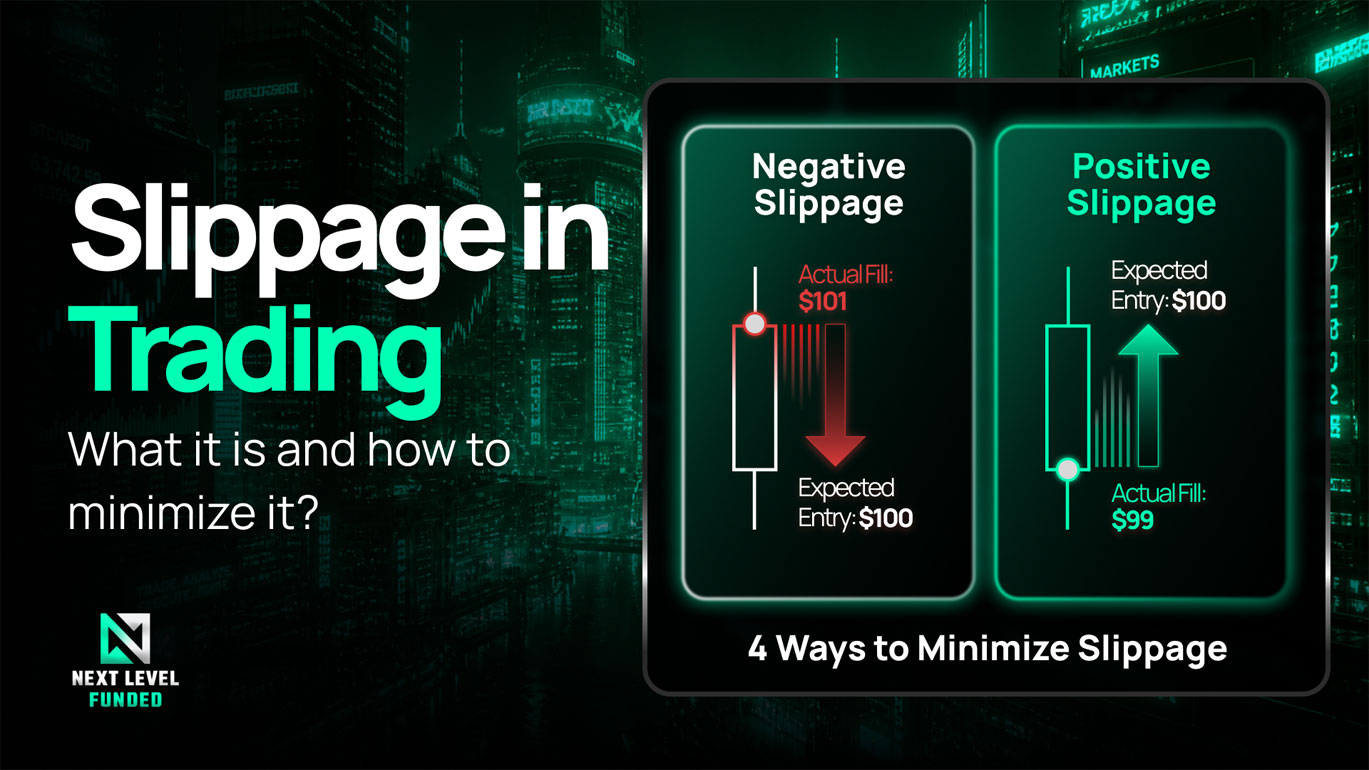
- Negative Slippage: You attempt to buy an asset at $100, but the order is filled at $101. You paid more than expected, reducing your potential profit. Or, your Stop Loss is set at $90, but due to a massive gap down, you are exited at $88, taking a larger loss than planned.
- Positive Slippage: You attempt to buy an asset at $100, but the price drops suddenly, and your order is filled at $99. You got a better price than expected, increasing your potential profit.
4 Ways to Minimize Slippage
While you cannot control the market, you can control how you interact with it. Here are four ways to minimize slippage and protect your capital:
1. Avoid Trading During Major News
The easiest way to avoid massive slippage is to step aside during high-impact news events. Check an economic calendar before your trading session. If NFP is releasing at 8:30 AM, close your open positions or tighten your stops before the release, and wait for the volatility to settle before re-entering the market.
2. Use Limit Orders Instead of Market Orders
A Market Order tells your broker: "Get me into this trade right now, at whatever the best available price is." This guarantees execution, but leaves you vulnerable to slippage. A Limit Order tells your broker: "Only get me into this trade at this exact price, or better." This guarantees your price and prevents negative slippage, though it carries the risk that your order may not be filled if the market doesn't reach your price.
3. Trade Highly Liquid Markets
Stick to the major forex pairs (EUR/USD, GBP/USD, USD/JPY) and major indices (S&P 500, NASDAQ 100). Because millions of participants are trading these assets every second, there is almost always a buyer or seller available at your desired price, keeping spreads tight and slippage minimal.
4. Trade with a Premium Prop Firm
Your execution speed is only as good as the broker or firm you trade with. Low-tier firms often use cheap liquidity providers, resulting in delayed execution and severe slippage.
At Next Level Funded (NLF), we partner with top-tier liquidity providers and offer industry-leading platforms like Match-Trader and MetaTrader 5. This ensures our traders experience lightning-fast execution speeds, ultra-tight spreads, and minimal slippage.
- Up to 100% Profit Splits
- On-Demand Payouts
- Raw Spreads and Premium Liquidity
- Instant Funding Options Available
Stop letting poor execution eat into your profits. Trade with a firm that provides institutional-grade trading conditions.
More Blogs


September 12, 2026
Can You Have Multiple NLF Instant Flex Accounts? $10K Limits, Larger Account Options & $500K Cap Explained
Read Story
September 8, 2026
Best $10K Instant Funded Account for Beginners? NLF Instant Flex Rules, Price and Payout Limit
Read Story© Next Level Funded 2026 | All Rights Reserved


