


.svg)


Ten years ago, if you wanted to trade a $100,000 account, you had two options: be incredibly wealthy or get hired by a Wall Street institution.
Today, the proprietary trading industry has democratized access to capital. Through "prop trading challenges," retail traders from anywhere in the world can prove their skills and gain access to massive amounts of funding.
But what exactly is a prop firm challenge? How do the rules work? And most importantly, are they actually worth your time and money? In this guide, we break down everything you need to know about prop firm evaluations in 2026.
How a Prop Trading Challenge Works
A prop trading challenge is essentially an audition. Proprietary trading firms have capital they want to deploy in the markets, but they need to ensure the traders managing that capital are disciplined and profitable.
To separate the professionals from the gamblers, firms require traders to pass an evaluation.
The Evaluation Process
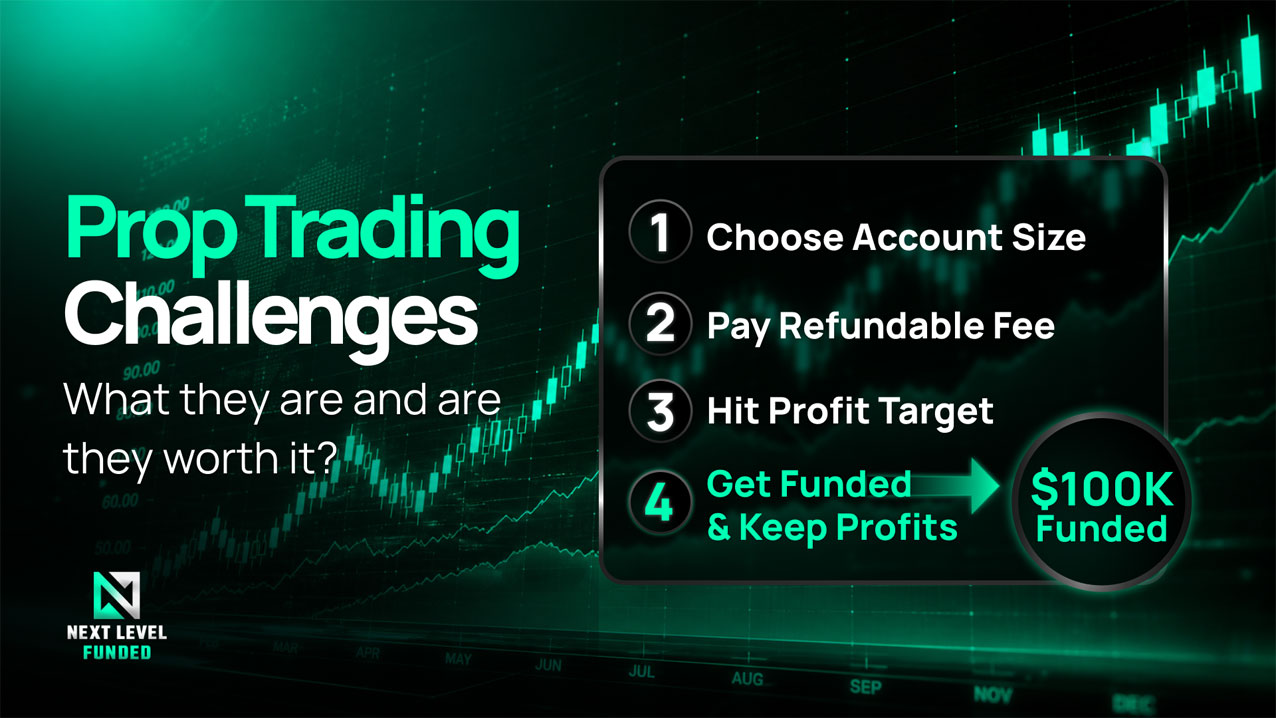
- Choose Your Account Size: You select the amount of capital you want to manage (e.g., $10,000, $50,000, or $100,000).
- Pay the Fee: You pay an upfront fee to take the challenge. This fee covers the firm's risk and operational costs. At top firms like Next Level Funded, this fee is 100% refunded to you with your first payout.
- Trade the Rules: You are given access to a simulated trading account. You must hit a specific Profit Target without violating the firm's Drawdown Limits (maximum allowed losses).
- Get Funded: If you successfully hit the target while following the rules, you pass the challenge. You are then given a funded account, and you keep the majority of the profits you generate.
The Standard Challenge Rules
While every firm is slightly different, almost all prop trading challenges revolve around three core metrics:
1. The Profit Target
This is the amount of money you must make to pass the challenge. In a standard 2-Step Evaluation, Phase 1 usually requires an 8% to 10% profit, while Phase 2 requires a 5% profit.
2. Maximum Daily Drawdown
This is the maximum amount your account equity or balance can drop in a single trading day. It is usually set at 4% or 5%. If you hit this limit, you fail the challenge immediately. This rule forces traders to use proper position sizing and stop losses.
3. Maximum Overall Drawdown
This is the maximum amount your account can drop from its initial starting balance. It is usually set at 8% or 10%.
1-Step vs. 2-Step Challenges
When browsing prop firms, you will typically see two types of evaluations:
Are Prop Firm Challenges Worth It?
The short answer is yes, absolutely—but only if you have a proven trading edge.
If you are a beginner who has never traded a demo account successfully, a prop firm challenge is a waste of money. You will likely hit the daily drawdown limit and fail.
However, if you are a consistently profitable trader currently trading a small $1,000 personal account, a prop firm challenge is the greatest leverage tool in modern finance.
If your strategy yields 5% a month:
- On a $1,000 personal account, you make $50.
- On a $100,000 funded account, you make $5,000 (and keep up to 100% of it).
The fee you pay for the challenge is negligible compared to the massive upside of trading six-figure capital.
Take the Next Level Funded Challenge
Not all prop firms are created equal. If you are ready to take a challenge, you need a firm that provides transparent rules, high profit splits, and reliable payouts.
At Next Level Funded (NLF), we offer the most trader-friendly evaluations in the industry:
- 1-Step and 2-Step Evaluations Available
- Instant Funding Options (Skip the Challenge Entirely)
- Up to 100% Profit Splits
- On-Demand Payouts
- 100% Refundable Challenge Fees
Stop grinding away on a small personal account. Prove your edge, pass the challenge, and get funded today.
More Blogs


September 12, 2026
Can You Have Multiple NLF Instant Flex Accounts? $10K Limits, Larger Account Options & $500K Cap Explained
Read Story
September 8, 2026
Best $10K Instant Funded Account for Beginners? NLF Instant Flex Rules, Price and Payout Limit
Read Story© Next Level Funded 2026 | All Rights Reserved


